
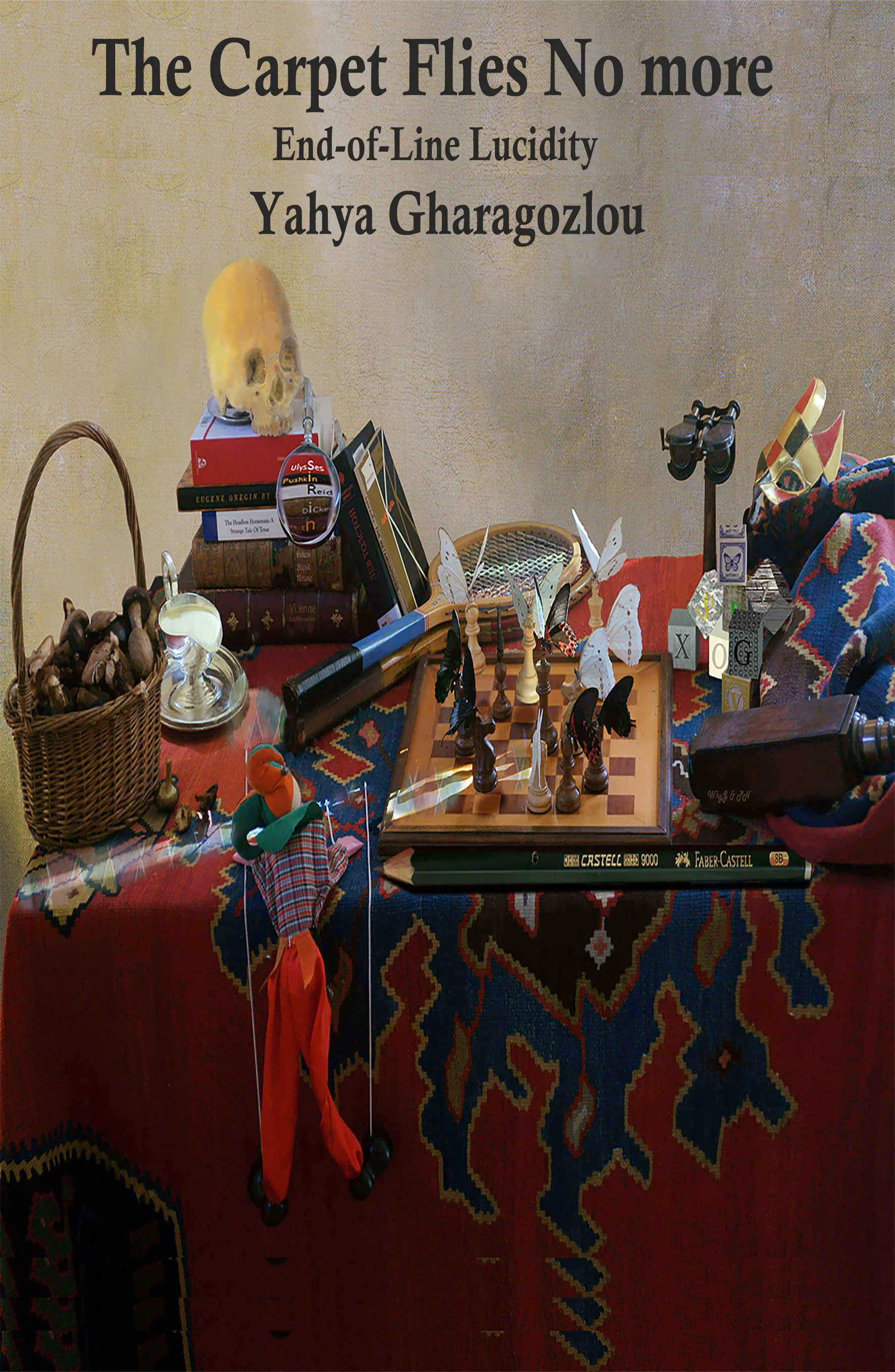
A Life Gently questioned
The Carpet Flies No More
A memoir of exile, memory, and vanished worlds
A life examined at the fault line between memory, belief, and the stories we dare to tell ourselves.
End-of-Line Lucidity is a literary memoir that reconstructs a life shaped by privilege, rupture, exile, and relentless self-inquiry. Moving from an aristocratic childhood in Tehran to the dislocations of revolution and migration, the narrator examines how memory is formed, distorted, and redeployed as narrative. The book interrogates the uneasy boundary between fact and invention, asking whether autobiography is ever more than curated fiction. Through family, education, desire, and intellectual awakening, it traces the making of a divided self—one that observes even as it lives. At its core, the work is a meditation on identity, time, and the fragile architecture of meaning. It is less a recounting of events than a reckoning with the mind that remembers them.
-
The Carpet Flies No More: End-of-Line Lucidity is a literary memoir about memory, class, family, exile, and the long argument a man conducts with himself as he tries to understand the life he has already lived. The narrator begins old enough to know that memory is unreliable and vain enough to write, anyway. From that position, he returns to his childhood in Tehran in the 1950s and 1960s, when the world still seemed large, familial, and absurdly secure. He grew up in a sprawling Iranian clan, in a household full of servants, relatives, governesses, rituals, comic humiliations, and private terrors. The memoir lingers less on public history than on the felt texture of a vanished life: the smell of rooms, the games between brothers, the moral confusions of privilege, the odd tyrannies of adults, and the first moments in which a child discovers shame, skepticism, desire, and solitude.
“The eraser rubs us out, leaving shavings. We translate our thoughts to paper using these shavings. We pick the ruts dug by the Ach neurotransmitter, like the etching of silicone. But who decided the depth of those ruts that guide me to recall 70 years of life with such arbitrary discrimination? In a running life, the peaks seldom match the imagined victories or defeats. We reconstruct our old life in a measly few hundred pages. Each recollection is a ghost in uniform, part of the Grande Armée behind ‘me.’”
As the book progresses, the bright surface of that former world gives way. His father fell on hard times financially. The family’s circumstances narrowed. The old Tehran of houses, gardens, and inherited confidence recedes. Then comes dislocation: school in England, social and emotional exile, educational mediocrity, private adaptation, and the formation of the divided self, the memoir calls “I” and “me.” The boy who survives these transitions becomes a man shaped by displacement but not defined by grievance. Revolution alters the country behind him, but the memoir insists that history, however violent, does not fully explain character. The deeper structure of the self was built earlier, in childhood weather, family dynamics, embarrassment, longing, and habit.
In later chapters, the memoir widens into adulthood: work, marriage, daughters, books, ambition deferred, and the late decision to write with full seriousness. The book asks what remains when status falls away, when countries vanish into memory, when parents become stories, and when the self must account for its own patterns. What emerges is neither a tale of victimhood nor one of triumph, but the record of a consciousness testing memory against form. End-of-Line Lucidity is a reckoning with the afterlife of childhood and with the difficulty of telling the truth about oneself when memory is both witness and accomplice. stories, and when the self must account for its own patterns. What emerges is neither a tale of victimhood nor one of triumph, but the record of a consciousness testing memory against form. End-of-Line Lucidity is a reckoning with the afterlife of childhood and with the difficulty of telling the truth about oneself when memory is both witness and accomplice.
-
From The Carpet Flies No More
Excerpt I — The Army Behind “Me”
The eraser rubs us out, leaving shavings. We translate our thoughts to paper using these shavings. We pick the ruts dug by the Ach neurotransmitter, like the etching of silicone. But who decided the depth of those ruts that guide me to recall 70 years of life with such arbitrary discrimination? The peaks seldom match the imagined victories or defeats in a running life. We reconstruct our old life in a measly few hundred pages. Each recollection is a ghost in uniform, part of the great army behind “me.”
To publish a novel is to declare a kind of vanity: it is the quiet presumption that thousands might want to move into the mental tenement you have imagined. Ego leaks through the book cover, no matter how you phrase the preface. Yet, to write an autobiography requires a bolder conceit. One must assume that one’s humdrum existence might tempt another’s attention.
Excerpt II — The Mechanics of Memory
Time erases us with efficient speed. Bodies disappear first. Names trail like charred paper fragments, gone in three generations. My brothers and I all had daughters; hyphenated double names proliferated like weeds. Double-barreled names clink together in genteel despair before they tumble off the genealogical chart, like loose buttons. I fancy a great-grandchild racing to a middle-aged grandchild: “Didn’t you say you had a Turkic ancestor? I think I found something he wrote.” No bell will toll in the antechamber of eternity, but the thought amuses me now, and that is enough. Salām, great-grandchild. He looks up my photo. I look to him the way an Edwadian or a Qajar might look to us.
Excerpt III — The Strobe Light of Childhood
Childhood came to me like an accordion. The world's noise came at me like slight breaths of the bellow: Gusts of tune, pockets of silence. There are incongruous memories, like the sleeper on a Swissair plane where today’s business-class overhead bin sits; it was converted or designed as a sleeper for children and left open. I know I slept in a crib like that. Could the airlines really have created such a dangerous contraption? Now, a peanut can ground a flight to a halt. I have no further memory of this trip. I have connected it to a different memory of my mother placing me in a Swiss pouponnière for a short time.
I make out a large milk vat and even taste a hint of the creamy yet cow-smelling, unpasteurized milk. And a nurse-like woman staring at me from above. A second taste, years later in the village of Poonak, brought back not a thousand pages of memory but an acid flash of dislike. If Swissair’s crib is a myth, the milk is not; memory binds them with the thread of its own spinning.