
An old world refuses to disappear even in exile
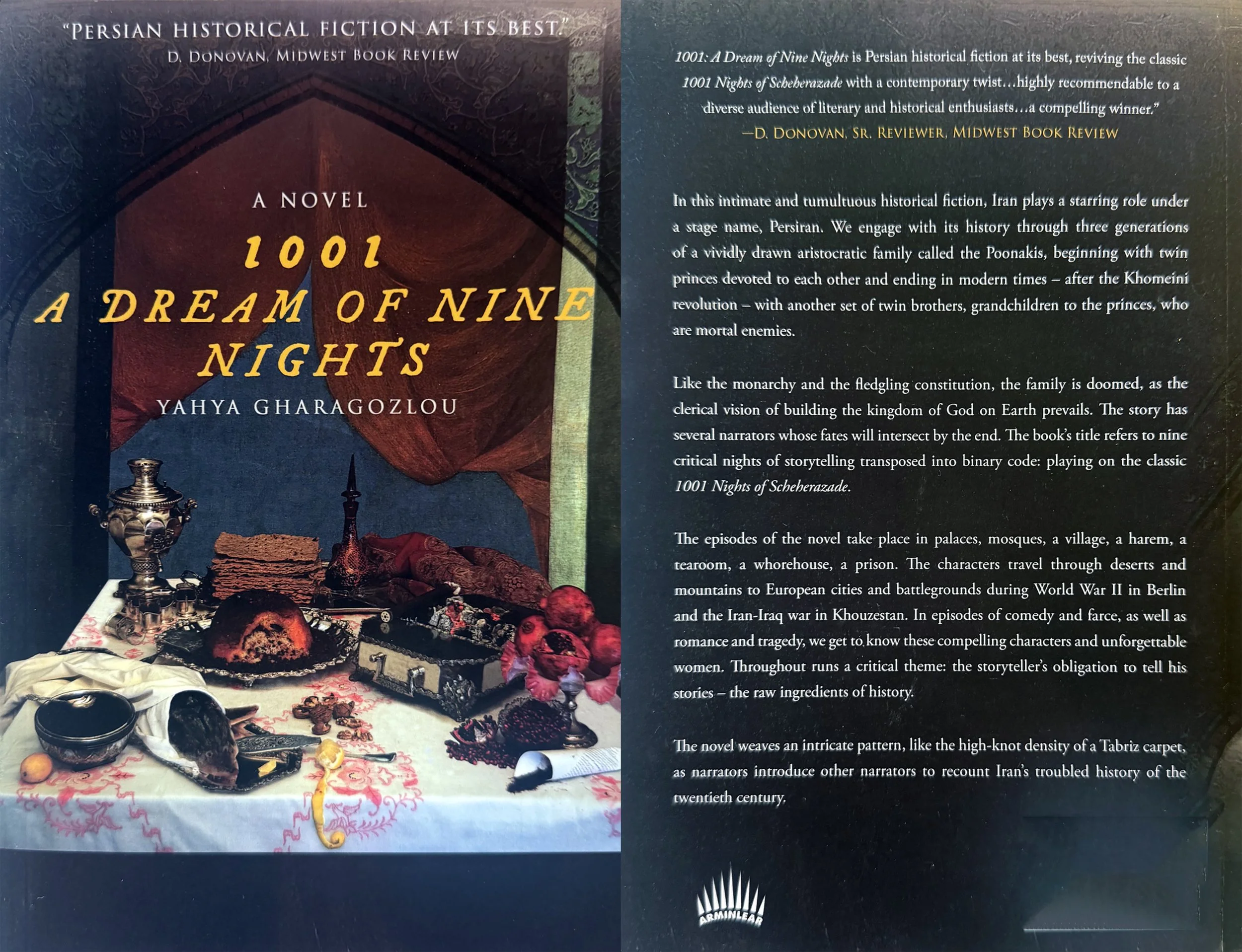
1001: A Dream of Nine Nights
Faith, power, and ambition collide at the birth of a nation
In this intimate and tumultuous historical fiction, Iran plays a starring role under a stage name, Persiran. We engage with its history through three generations of a vividly drawn aristocratic family called the Poonakis, beginning with twin princes devoted to each other and ending in modern times - after the Khomeini revolution - with another set of twin brothers, grandchildren to the princes, who are mortal enemies.
Like the monarchy and the fledgling constitution, the family is doomed, as the clerical vision of building the kingdom of God on earth prevails. The story has several narrators whose fates will intersect by the end. The book's title refers to nine critical nights of storytelling transposed into binary code, playing on the classic 1001 Nights of Scheherazade.
The novel’s episodes take place in palaces, mosques, a village, a harem, a tearoom, a whorehouse, and a prison. The characters travel through deserts and mountains to European cities and to World War II battlefields in Berlin, and to the Iran-Iraq war in Khouzestan. In episodes of comedy and farce, as well as romance and tragedy, we get to know thesę compelling characters and unforgettable women. Throughout runs a critical theme: the storyteller's obligation to tell his stories - the raw ingredients of history.
-
“A great work of literature and of historical fiction.”
Ann F.1001: A Dream of Nine Nights is a fascinating and complex novel that traces a princely Iranian family across generations. Inspired by the tradition of epic storytelling, it weaves a rich narrative of power, memory, and transformation against the shifting regimes of modern Iran.
“Enchanting writing… a fantastic story.”
firooz · Verified PurchaseThe prose is vivid and immersive, drawing the reader into a world rendered with color, rhythm, and emotional force. The narrative does not simply unfold—it surrounds and holds the reader in its spell.
“Like a Russian nesting doll.”
John P. TylerA layered and intricate narrative in which stories unfold within stories, voices echo across generations, and history is reconstructed through memory and storytelling. The novel captures both the immediacy of lived experience and the vast sweep of cultural change.
“At the table of Márquez, Allende… set a seat for Gharagozlou.”
sbna · Verified PurchaseA rare combination of literary depth and compelling storytelling—where characters linger, histories breathe, and fiction reaches toward something enduring.
“Beautiful and gripping… I couldn’t stop thinking about it.”
CrystalA sweeping, multi-generational novel that is both emotionally resonant and historically illuminating—one that invites return and reflection long after the final page.
-
The Writer Narrator
Titling a book 1001 comes with responsibilities. I don’t defend the improbability of the number. An ancient tome lingers in our minds—One Thousand and One Nights. Yet how many do we honestly remember? We allow for poetic license. There will be times in this accurate historical monograph when I plead for it; this is not merely a recounting of history but a journey through layers of storytelling.
The 1001 structure mirrors modern oral history: multiple voices recounting the same world. Truth, after all, is a mosaic. My early readers warned me that numerous narrators confuse naïve readers. “Not us, of course,” they said, “but the non-reader reader.” I will check back with you after each night. But you are not confused, are you? I, the writer—a name on a cover, a whisper of ink—will be your guide.
The Narrator:
It has been many years since you approached me, offering to serve as a volunteer editor for the newly conceived Encyclopedia Persiranica. If I recall correctly, it was at the Qajar Conference at the Copley Place Marriott in Boston. You asked me to contribute an entry on my family, the Poonakis. I still recall how delicately you tried to hurry me along… your left heel tilting back, your right hand absently chasing your Hermès scarf as it slipped against your blue-black hair. You looked so young. I asked you if you attended a local school. You told me, impatiently, you had finished your dissertation in Edinburgh.
Us is a strange pronoun. It suggests inclusion, yet we wield it like a fence, enclosing ourselves within an elite company. Please don’t take offense. I am not in a position to be snooty and haven’t been for some time. As a historian, you are familiar with the Thousand Family nomenclature. I count à peine forty families left—all interwoven, all cozy. An endangered species, no doubt. But are we worth saving? In time, neglect will do what persecution once did. Soon, there will be little reason to hunt our not-so-shiny pelts.
How to describe the Poonaki family tree? Diagrammatically, it resembles an hourglass. Identical twin princes form its pillars. One marries an aristocratic French beauty and has a daughter. The other weds the king’s granddaughter and has a son. The cousins, in turn, marry, producing a final pair of fraternal twin boys, sterile, ending the Poonakis in three generations. A genetic palindrome. An ancestral echo falls into silence.
The Fat Narrator
I, Salman Hekaiatchi, a direct descendant of the mighty Ferdowsi… was reduced to serving tea in my own establishment. My tearoom, once a jewel of the Grand Bazaar, now stinks of urine. Built by the great Karim, the Golden Tearoom was famous for its mosque-like gold cupola. Princes, cabinet members, and wealthy merchants once held court here. Now it belongs to dealers, murderers, Afghanis, Palestinians, addicts—every form of lowlife imaginable.
The laughter was deafening, an ovation worthy of my father. Hamid squeezed the back of my neck, making my skin bulge between his fingers. “Our storyteller tells stories as well as he eats,” he said, “and you can see he is magnificent at eating.” I set my tray down, the silver tea service clinking, and stepped forward. In that moment, everything became clear—to them and to me. I was no longer a partner. No longer a storyteller. I was a servant.
The Professor Narrator
Did you know that One Thousand and One Nights happened over nine hundred and eighty-one nights? Scheherazade took twenty nights off to give birth to the King’s twins. The math betrays the myth. Yet calling it A Thousand and One Nights rather than rounding it off to a thousand was a stroke of genius, a marketing triumph. We allow for poetic license. There will be times in this accurate historical monograph when I plead for poetic license; this is not merely a recounting of history but a journey through layers of storytelling.
The 1001 structure mirrors modern oral history, a genre revived in the twentieth century—multiple voices recounting, say, World War II. Truth, after all, is a mosaic. My early readers fed back to me, warning me that numerous narrators confuse naïve readers. “Not us, of course, but the non-reader reader.” I will eat the feed. I will check back with you after each night. But you are not confused, are you?